



Kitchen
Butler's Pantry Renovation Cost: What Different Budgets Buy
10.15.2026
10.15.2026


In This Article
Your kitchen cabinets are already full, and every party means clearing counter space for serving dishes, drinks, and the coffee maker. A butler's pantry gives all of that its own room, and a butler's pantry renovation costs anywhere from $8,000 for a cabinetry refresh to $40,000 or more for a full prep pantry with its own sink and appliances. That range comes down to how much you ask the room to do, so the first budget decision is which jobs you want it to take off the main kitchen.
A basic butler's pantry refresh costs $8,000 to $15,000 when the room already exists and the work stays with cabinetry, countertops, and finishes. Converting a neighboring room runs $15,000 to $25,000, and a fully equipped prep pantry with plumbing and appliances reaches $25,000 to $40,000 or more. A very small cosmetic update can come in under $8,000, and new construction or structural changes push past the top of the range.
|
Project tier |
Typical cost |
What pushes it higher |
|---|---|---|
|
Refresh an existing pantry |
$8,000 to $15,000 |
Custom cabinetry, stone countertops, new lighting circuits |
|
Convert a neighboring room |
$15,000 to $25,000 |
Adding a sink, new electrical service, flooring and wall repair |
|
Build a full prep pantry |
$25,000 to $40,000 or more |
Dishwasher and refrigeration, long plumbing runs, cooking appliances and ventilation |
Cabinetry takes the largest share in every tier, and plumbing changes the total most once you add a sink. The ranges below assume a room of 40 to 80 square feet with a single run of cabinets on one or two walls.
|
Component |
Typical installed cost |
What changes the number |
|---|---|---|
|
Cabinetry |
$150 to $400 per linear foot for stock, $600 to $1,200 or more for custom |
Inset doors, furniture-style fronts, interior organizers |
|
Countertops |
$500 to $5,000 for a typical 15 to 25 square foot run |
Stone versus laminate, a waterfall edge, a second surface |
|
Sink and plumbing |
$1,500 to $4,000 near existing lines, $4,000 to $8,000 or more for a new drain run |
Distance to the nearest drain, finished walls or floors in the way |
|
Electrical and lighting |
$1,500 to $4,000 |
Number of new circuits, undercabinet and recessed fixtures |
|
Appliances |
$1,500 to $6,000 |
Undercounter refrigeration, a dishwasher, panel-ready fronts |
|
Flooring, paint, and trim |
$1,000 to $5,000 |
Matching existing hardwood or millwork |
|
New doorway or wall removal |
$1,000 to $3,000 for a non-bearing wall, $3,000 to $10,000 or more for a bearing wall |
Engineering, a beam, patching the adjoining rooms |
Add the components you want, then set aside 10 to 20% as a contingency. Older houses in particular tend to reveal uneven floors, deteriorated plaster, or outdated wiring once the old shelving comes out, and that reserve is what keeps those discoveries from stalling the job.
Design a Home That’s Uniquely Yours
Block can help you achieve your renovation goals and bring your dream remodel to life with price assurance and expert support.
Get Started
Budget: $8,000 to $12,000
A room next to the kitchen or dining room that already has sound walls, a usable floor, outlets, and a doorway needs no construction, so the whole budget goes to cabinetry and finishes.
This tier makes sense when the goal is freeing up the main kitchen rather than creating a second place to cook. You can leave the sink question for a later project, and the whole job often fits in two to three weeks.
Budget: $15,000 to $25,000
A breakfast nook or storage room that has never held cabinetry needs more than cabinets. Walls get patched, flooring changes, the doorway is often reworked, and the electrical panel has to supply circuits the room never had.
This is the tier where you decide whether the room does more than store and serve, because every appliance you add also adds a circuit and sometimes a water line.
Budget: $25,000 to $40,000 or more
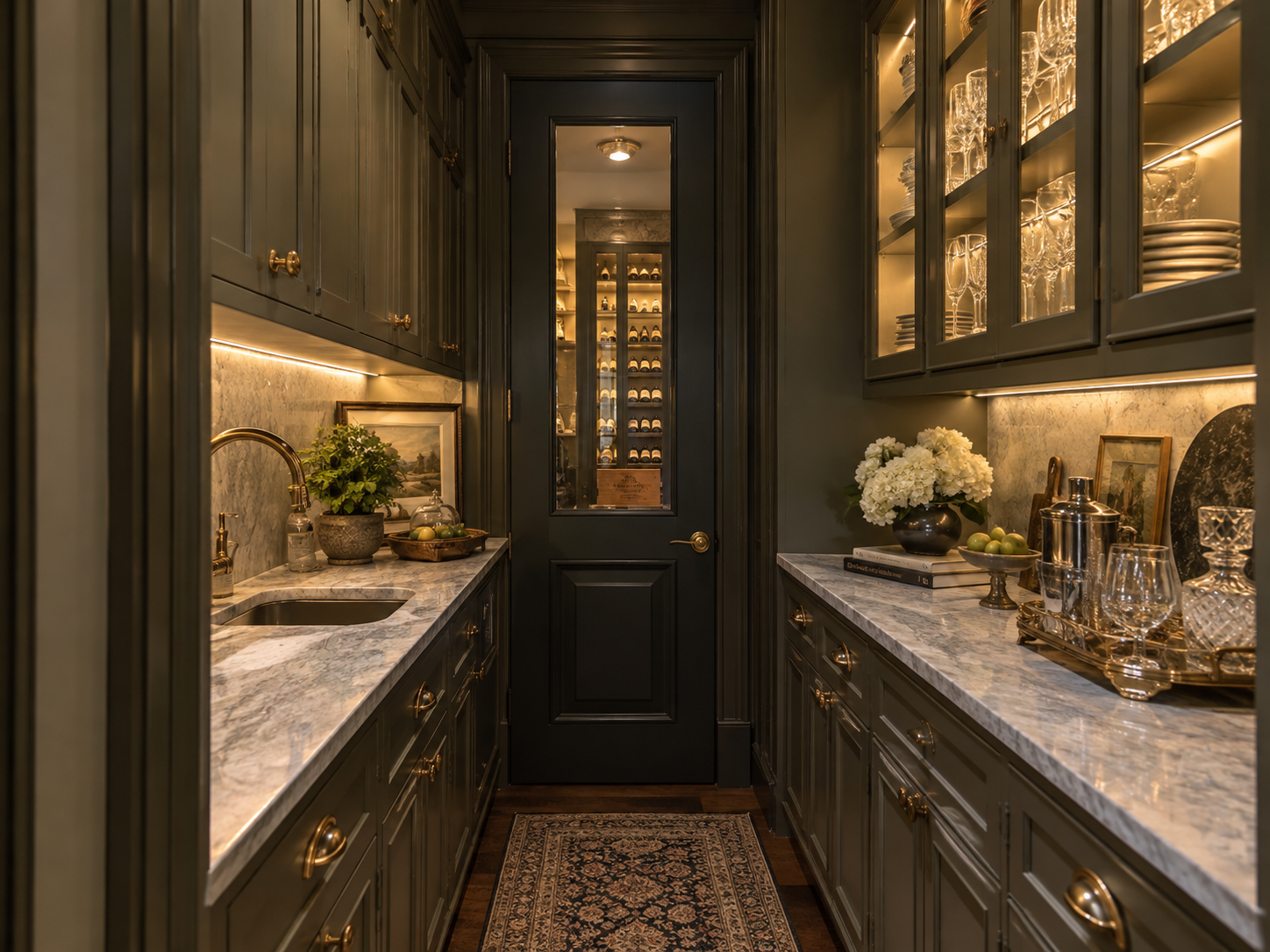
A prep pantry at this budget functions as a second kitchen in everything but the stove. Custom cabinetry, a sink, a dishwasher, undercounter refrigeration, and long counter runs are standard, and the construction to support them often costs as much as the equipment itself.
The same scope costs the least when the room shares a wall with the kitchen, and plumbing and electrical runs to the far end of the house can add $10,000 on their own.
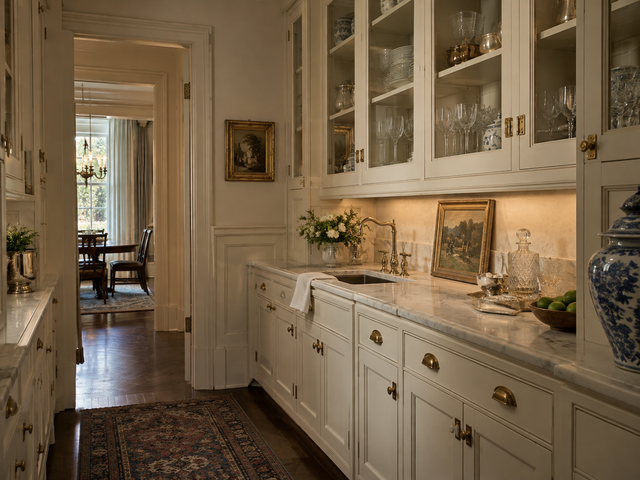
Yes, and in a prewar house it is often the better-value project. Original cabinet doors, brass hardware, wood shelving, and a built-in serving counter can be stripped, repaired, and refinished for less than new custom millwork of the same quality, and the finished room matches the millwork in the rest of the house.
Still, restoration has limits. Shelving that has racked out of square, plaster behind it that has failed, or wiring that predates grounded outlets all need replacement. A careful contractor prices repair and replacement side by side so you can see the difference, and when some elements are beyond saving, reproducing their proportions and door profiles keeps the room's relationship to the rest of the house.
Restraint applies to the room itself, too. Widening an original doorway or removing a partition opens up the floor plan but erases details that give the house its character. In most cases, keeping the room arrangement and spending the difference on better cabinetry is the more satisfying renovation, and adding plumbing deserves the same scrutiny, since a new drain line can mean cutting into original floors.
Match the spending to the jobs the main kitchen handles badly, and skip any feature that doesn't address one of them.
A closet-to-pantry conversion covers the same decisions at a much smaller scale.
A sink is worth it when you regularly rinse glassware, prep drinks, or clean up without walking back to the main kitchen. It is wasted money when the room mostly holds dishes, coffee supplies, and serving pieces that never get wet.
A faucet and basin cost $300 to $800, and the rest of the sink budget is installation. The installation needs hot and cold supply lines, a drain with proper venting, and a cabinet built around all of it, and that is a routine job when the kitchen's plumbing sits on the other side of the wall. When the nearest drain is 15 feet away, the contractor opens finished walls or floors to route and vent a new line, and the $2,000 sink becomes a $6,000 one. And that's before you get to patching the walls you opened.
The same arithmetic applies to rerouting plumbing anywhere in the house. If the pantry will mostly store and serve, skip the sink and put that $2,000 to $6,000 into cabinetry.
Often it does. A new doorway or a removed wall can cost more than every cabinet in the pantry, because the work reaches framing, flooring, trim, lighting, and the way people move between rooms.
Expanding a narrow pantry into an adjoining hall is the common version of this. Opening a non-bearing wall runs $1,000 to $3,000, and a bearing wall adds an engineer, a beam, and $3,000 to $10,000 or more. Floors and trim on both sides need patching, and the hall gives up a function the house may still need.
If what you really want is food storage, a small walk-in pantry needs less width and no counter, and the layout requirements are different enough to compare before you commit to a wall.
You get the most from a butler's pantry budget when the contractor's scope lists every circuit, drain run, and cabinet line before the price is set, because that is where pantry quotes diverge. Tell Block Renovation your pantry details once and have up to four vetted local contractors compete for the project, with a Block project planner reviewing each proposal for missing line items before you sign. In a prewar house, that review is also where restoration versus replacement gets spelled out line by line, so the quote reflects the details you want to keep as well as the features you want to add.
Remodel with confidence through Block

Connect to vetted local contractors
We only work with top-tier, thoroughly vetted contractors

Get expert guidance
Our project planners offer expert advice, scope review, and ongoing support as needed
Enjoy peace of mind throughout your renovation
Secure payment system puts you in control and protects your remodel

Renovate confidently with Block
Easily compare quotes from top quality contractors, and get peace of mind with warranty & price protections.
Kitchen
Butler's Pantry Renovation Cost: What Different Budgets Buy
10.15.2026
Kitchen
Installing Kitchen Range Hood Venting: Costs and Options
10.13.2026
Kitchen
Kitchenette Installation Cost: Plumbing, Appliances & Labor
10.09.2026

Kitchen
50k Kitchen Remodel: What $50,000 to $60,000 Buys
09.21.2026
Kitchen
New York City Kitchen Remodels: Cost, Permits & Contractors
09.18.2026