



Countertops
Laminate Countertops vs. Quartz: How to Choose
09.15.2026
09.15.2026


In This Article
Laminate gets dismissed too quickly. Today’s better patterns and matte finishes bear little resemblance to the shiny, obviously printed counters many homeowners remember, while quartz isn’t as indestructible as its reputation suggests. Put two good samples side by side and the visual difference is surprisingly small, even though the installed prices can be three to five times apart.
Start with your cooking habits and the sink you want, then look at what quartz would take from the rest of the renovation budget. That will tell you more than a six-inch sample under bright display lighting. This guide assumes professional installation in a kitchen; in a laundry room, basement bar, or guest bathroom, lighter use often gives laminate a decisive advantage.
| Factor | Laminate | Quartz |
|---|---|---|
| Installed cost per square foot | $20 to $50 | $50 to $120 |
| Typical service life | 10 to 15 years | 25 years or more |
| Sealing required | No | No |
| Heat | Use a trivet; prolonged heat can discolor the surface or weaken the adhesive | Use a trivet; high heat and sudden temperature changes can damage the surface |
| Undermount sink | Requires a compatible sink and experienced fabricator | Standard |
| Repair after damage | Usually requires replacing the damaged section | Epoxy can fill chips, but repairs remain visible on many patterns |
The biggest difference between laminate and quartz countertops is how much durability you gain for the higher price. Quartz’s tougher surface and straightforward undermount installation justify that added cost in a busy primary kitchen. If the upgrade would take money from cabinets, lighting, or other work that will improve the kitchen more, laminate is the better trade.
Neither laminate nor quartz countertops need routine sealing, although the construction underneath is very different. Laminate is a printed decorative sheet bonded under heat and pressure to a particleboard or MDF core. High-pressure laminate, the grade used for countertops, has a thicker wear layer than the low-pressure material commonly used on cabinet interiors. The core keeps the counter light and inexpensive, but water damage becomes permanent once moisture reaches it.
Quartz countertops combine crushed quartz with polymer resin and pigment before the mixture is pressed and cured into slabs. Because the finished slab is nonporous, spills don’t penetrate the surface easily. Resin creates the material’s vulnerability to high heat, a detail that receives far less attention than quartz’s durability.
Turn your renovation vision into reality
Get matched with trusted contractors and start your renovation today!
Find a Contractor
Laminate costs about $20 to $50 per square foot installed, compared with $50 to $120 for quartz. For 40 square feet of counter, that’s roughly $800 to $2,000 for laminate and $2,000 to $4,800 for quartz. Three details determine where your estimate falls:
In a counter-only project, a $2,500 quartz upgrade can consume most of the budget. When the countertop is the whole project, laminate is often the easy choice, especially when the existing cabinets aren’t valuable enough to justify an expensive surface. If quartz forces you to postpone better lighting or keep damaged cabinets, spend the money elsewhere.
During a full renovation, the crew is already there and the sink is already disconnected. New cabinets should last for decades, so quartz becomes an incremental upgrade rather than the project’s defining expense. Still, don’t buy elaborate premium laminate that costs nearly as much as a basic quartz you genuinely prefer; laminate works best when it saves meaningful money.
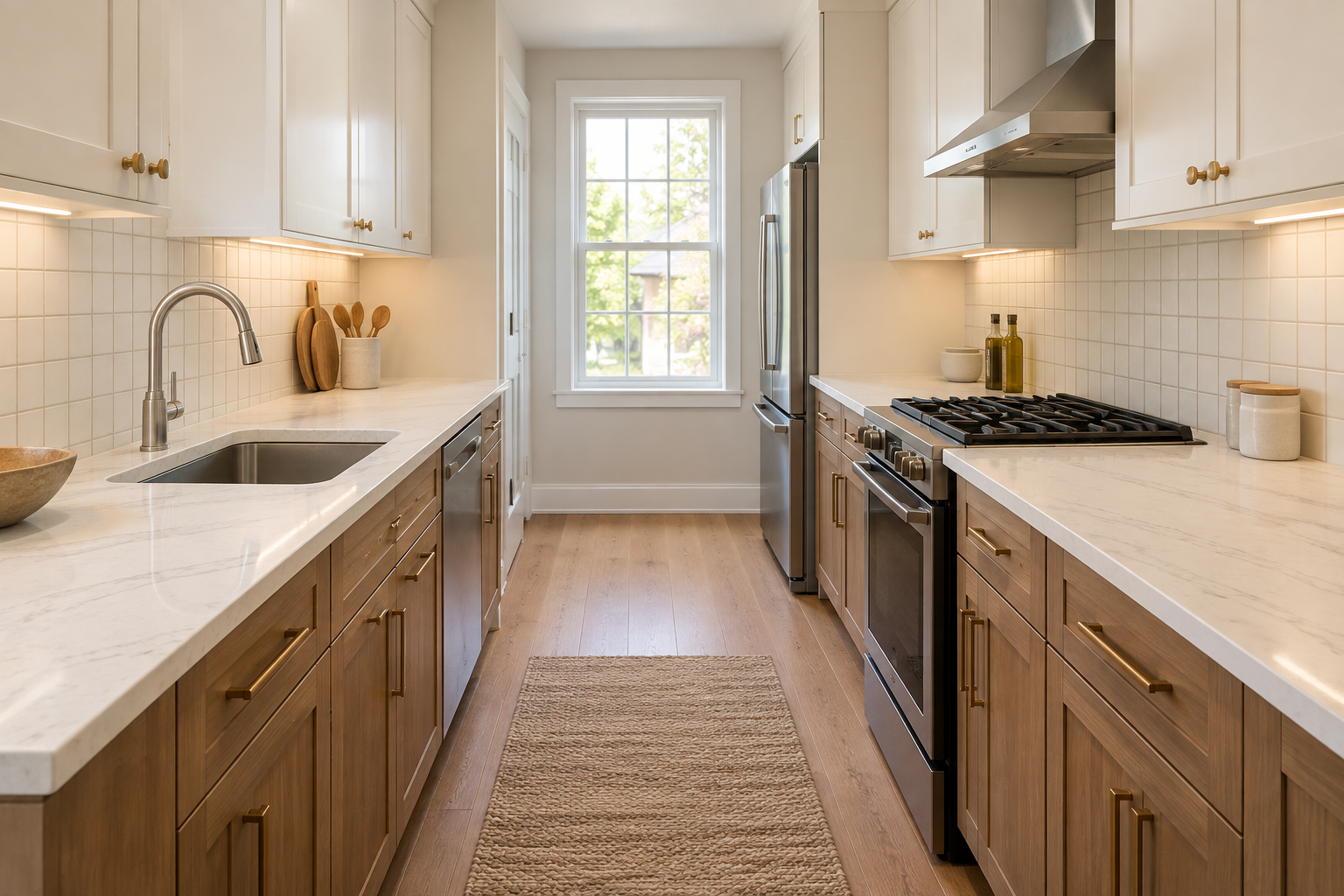
For a kitchen that gets cooked in every night, quartz is easier to live with. Wine, turmeric, coffee, and olive oil wipe away, while ordinary prep work rarely leaves a scratch. You should still use a cutting board, but a rushed dinner won’t demand constant attention to the counter.
With laminate, knives and abrasive cleaners cause more trouble. Cutting directly on the surface leaves a permanent mark, harsh scrubbing dulls the finish, and a deep gouge exposes the water-sensitive core. Pale patterns can also show wear sooner around the sink and main prep area, even though everyday spills clean up better than laminate’s reputation suggests.
Deep scratches and chips are permanent problems on both surfaces. In a primary kitchen, quartz’s tougher surface makes the higher price easier to justify. Laminate holds up well when the savings are substantial and everyone in the household can manage cutting boards and trivets.
Here’s the useful part: don’t set a dry pan directly from the range on either surface. Wilsonart says maintained temperatures around 285°F can discolor laminate, while contact adhesive can soften around 200°F and repeated heating above 150°F can cause deterioration. Caesarstone describes quartz as heat-resistant rather than heat-proof and warns that its resin can burn at approximately 150°F. The manufacturers use different tests, so the numbers don’t create a head-to-head ranking. Both still tell homeowners to use trivets.
Keep trivets beside the range and put slow cookers, air fryers, and electric griddles on a protective mat. Frequent high-heat cooking also makes a butcher block or stainless insert beside the range worth considering. Don’t choose between laminate and quartz on heat resistance alone; both require protection from hot cookware.
The lifespan of a laminate counter is frequently decided at the sink. Particleboard and MDF swell after water reaches them, causing the decorative surface to lift or deform. Once that damage appears, replacing the affected section is the only credible repair.
Water reaches the core through four common trouble spots. Those weak points deserve attention during installation and whenever you check the caulk.
You may not notice a leak until the core has already swollen. A drop-in sink reduces the risk because its wide rim covers the cutout, and you can see the caulk bead from above when it starts to fail. The look isn’t as streamlined as an undermount sink, but this setup helps a well-installed laminate counter last 15 years.
If you want an undermount sink, laminate becomes harder to justify. Karran and several other manufacturers make compatible sinks, but installation depends on a specialist and a durable seal. Quartz avoids that specialty fabrication and reduces the water risk around the cutout.
Deep damage remains visible on either material. A fabricator can fill a chipped quartz corner with color-matched epoxy, and the result blends best into solid or heavily speckled patterns. Distinct veining is harder to reproduce, so the repair remains easier to spot whenever the light catches it.
A quartz slab ordered several years later can come from a different dye lot and fail to match the original counter, turning a partial replacement into a much larger job. Engineered quartz also can’t be re-honed in place until a deep chip disappears.
Laminate costs less to replace. A damaged top can come off the cabinets quickly, and even a complete replacement may cost less than replacing one substantial section of quartz. Quartz’s longer lifespan matters most when you expect to keep the kitchen long enough to benefit from it.
Not sure how to begin your renovation?
Get free, expert guidance from a dedicated Block Project Planner who can help you navigate proposals, timelines, contractor selection, and more.
Book A Free Consultation
Full-slab prints, matte finishes, and better textures have made good laminate far more convincing. Quartz still has greater visual depth at close range, but poor designs can look repetitive and artificial, so judge the actual samples in your kitchen instead of choosing by material name.
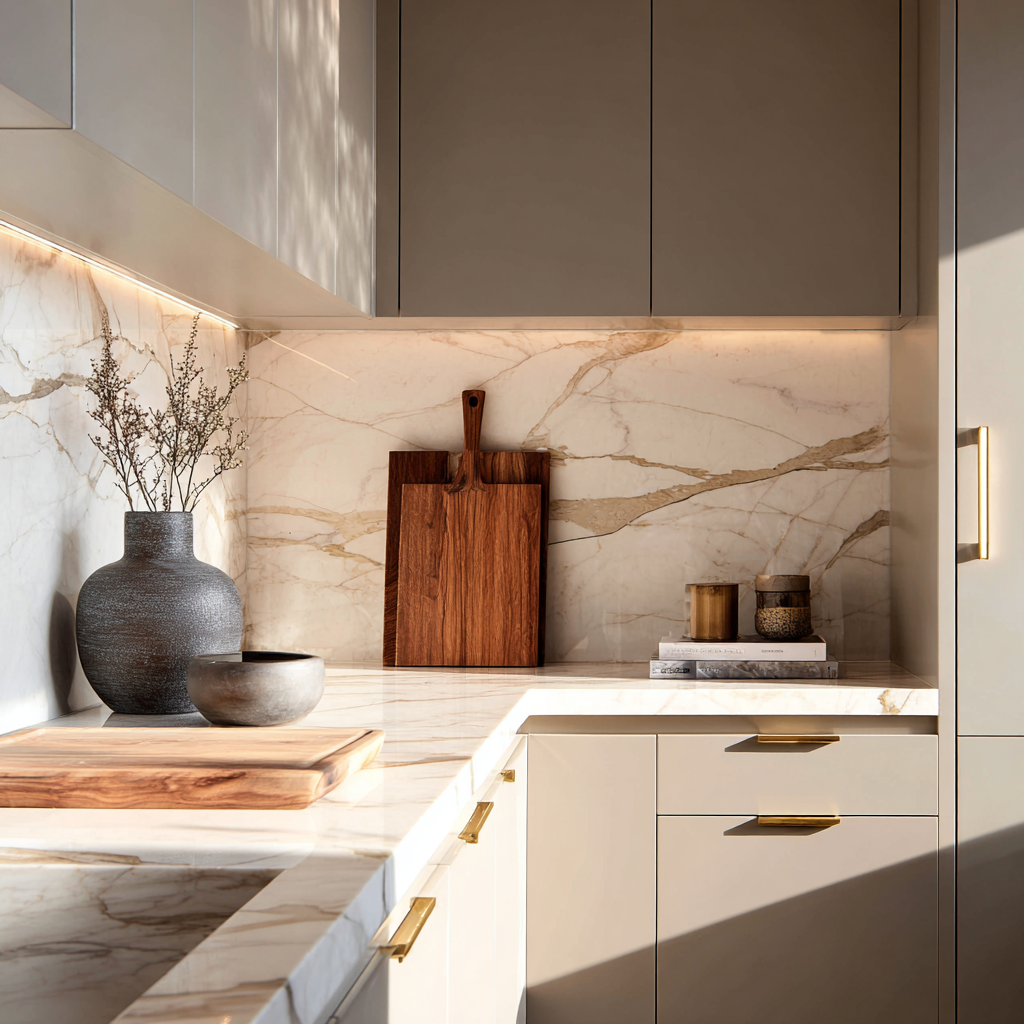
Look at the edge profile before getting attached to a color. Laminate has to wrap or conceal a wood-based core, while quartz fabrication supports several details that laminate can’t reproduce convincingly.
Spend on these details only when the counter is one of the kitchen’s main design features. If you want a simple surface that recedes behind the cabinets and backsplash, choose laminate and skip the expensive edge work.
Considering the weight of quartz vs. laminate
A 3-centimeter quartz slab weighs about 18 to 20 pounds per square foot, putting a large island section well into the hundreds of pounds. Most sound base cabinets support that weight, but older, poorly installed, or water-damaged cabinets need to be checked before templating. Large sections also require more installers and careful planning around narrow doors, stairs, and tight corners.
If you’re updating an otherwise usable kitchen, laminate offers a faster installation with less disruption. A two-person crew can carry a full run through a doorway and finish a straightforward layout in a day, while quartz must be templated and fabricated before installation. Ask whether the estimate covers removal, disposal, sink disconnection, reconnection, and cabinet reinforcement, since those exclusions create more surprises than the square-foot price.
Choose laminate when it gives you a visibly fresher kitchen for well under the price of stone. It fits counter-only updates over existing cabinets, rental properties, homes you expect to sell within several years, and layouts that already use a drop-in sink. Laundry rooms, basement bars, guest suites, and secondary bathrooms rarely receive enough abuse to justify quartz solely for durability.
Laminate can also look better than the cheapest quartz in a supplier’s showroom. A matte laminate with a restrained pattern will beat engineered stone with clumsy, repeated veining, and the lower-status material name shouldn’t push you toward the uglier counter.
Choose quartz for a primary kitchen that sees daily cooking, frequent spills, and years of hard use. It also fits renovations with new cabinets, an undermount sink, a waterfall end, or a thick mitered edge. If the cabinetry and layout are expected to last 20 years or more, quartz’s longer service life reduces the chance of another countertop project halfway through.
A mid-range renovation with sound existing cabinets and a drop-in sink leaves room for either material. Price both against the same complete scope, then view the samples beside your cabinet finish in morning and evening light; if laminate still looks good, the savings can fund cabinets, lighting, or plumbing work behind the wall. Choose quartz when its durability matters more than those competing upgrades.
Before you choose a material, find out whether the existing cabinets can support quartz and whether an undermount laminate sink is practical for your project. Removing the current counter can also expose plumbing or cabinet damage that wasn’t visible during the initial walkthrough. Your contractor should investigate those conditions and include any added work in the scope.
Block experts review the scope before you commit, helping identify missing line items early, while secure payments are released as the project progresses. You get a clearer comparison before construction begins and won’t have to pay a contractor directly for work that hasn’t been completed.
Remodel with confidence through Block

Connect to vetted local contractors
We only work with top-tier, thoroughly vetted contractors

Get expert guidance
Our project planners offer expert advice, scope review, and ongoing support as needed

Enjoy peace of mind throughout your renovation
Secure payment system puts you in control and protects your remodel

Renovate confidently with Block
Easily compare quotes from top quality contractors, and get peace of mind with warranty & price protections.
Countertops
Laminate Countertops vs. Quartz: How to Choose
09.15.2026
Countertops
Kitchen Counter Overlay: Cost, Durability and More
09.13.2026
Countertops
What Color Countertops Go With Oak Cabinets?
09.01.2026
Countertops
Walnut Cabinets With White Countertops
08.24.2026
Countertops
What Color Cabinets Go With Black Granite Countertops?
08.16.2026