



Living Space
Bump Out Living Room: Cost, Feasibility & Options
09.06.2026
06.30.2026


In This Article
If your bedroom shares a hallway bathroom with the rest of the house, and your closet is a single rod behind a folding door, a master suite addition fixes both at once. A 400 sq. ft. master suite, also called a primary suite, gives you a private bedroom, an en-suite bath, and a walk-in closet, and the cost usually runs $120,000 to $300,000 or more. Where you land depends on whether you convert existing space, bump out, build up, or pour a new foundation for a full extension. The low end reuses existing structure and plumbing or keeps the layout simple. The top of the range comes from a ground-up build in an expensive market, a large bathroom, and high-end finishes.
A 400 sq. ft. suite gets priced like a small home addition with a full bathroom built into it, plus the structural and exterior work to tie it into the house. That combination is what pushes the cost well past a plain bedroom addition, far more than the square footage alone would suggest.
The cost to add a 400 sq. ft. master suite runs from about $120,000 to $300,000 or more, which works out to roughly $300 to $750+ per square foot. That runs higher than a standard room addition because a full bathroom, new plumbing, and finished closet space are built into the footprint.
The biggest swing factor is how you add the space. Reusing existing structure costs far less than building new walls, a foundation, and a roof.
|
Budget tier |
Typical total |
What it usually looks like |
|
Lower |
$120,000 to $170,000 |
Existing-space conversion or bump-out, standard finishes, bathroom placed near existing plumbing |
|
Middle |
$170,000 to $240,000 |
Ground-floor addition with new foundation and roof tie-in, mid-range bathroom and closet |
|
Higher |
$240,000 to $300,000+ |
Second-story addition or high-cost metro build, large bathroom, custom closet, premium finishes |
These ranges reflect the usual cost drivers for primary suite additions: structural work, bathroom plumbing, HVAC, finish level, permitting, and regional labor rates. Final pricing depends on site conditions, local code, contractor availability, and the exact scope, so treat the figures as a planning starting point until a contractor prices your specific job.
Where your project lands inside that range comes down to scope. Put a defined scope in front of vetted contractors and compare what they bid. Block Renovation can match you with local pros and review their scopes for missing line items before you commit.
Turn your renovation vision into reality
Get matched with trusted contractors and start your renovation today!
Find a Contractor
Most estimates in this range assume a full suite finished to a livable, permitted standard:
A few costs sit outside a typical estimate and surface only after a contractor or designer looks at your specific house and lot. Older homes, marginal electrical panels, and stressed sewer or septic systems are the usual culprits, and the section on hidden costs covers the full set.
A bedroom addition is mostly framing, drywall, flooring, and a couple of outlets. A primary suite layers a full bathroom, a finished closet, and the systems to run both on top of that. For comparison, a bedroom remodel that reworks an existing room runs far less, since it skips the bathroom and the structural work entirely.
The bathroom does most of the damage. New supply lines, drains, venting, waterproofing, tile, fixtures, and a vent fan turn a small share of the square footage into a large share of the budget, and a more elaborate master bathroom pushes it higher still. A suite addition also means a new foundation, an exterior wall assembly, and a roof that ties back into the existing house, each carrying its own labor and material cost. The closet, often an afterthought, adds millwork and sometimes its own lighting and trim.
Added up with a contingency, the line items below land near the headline range: roughly $120,000 for a straightforward build and past $300,000 for a complex or premium one.
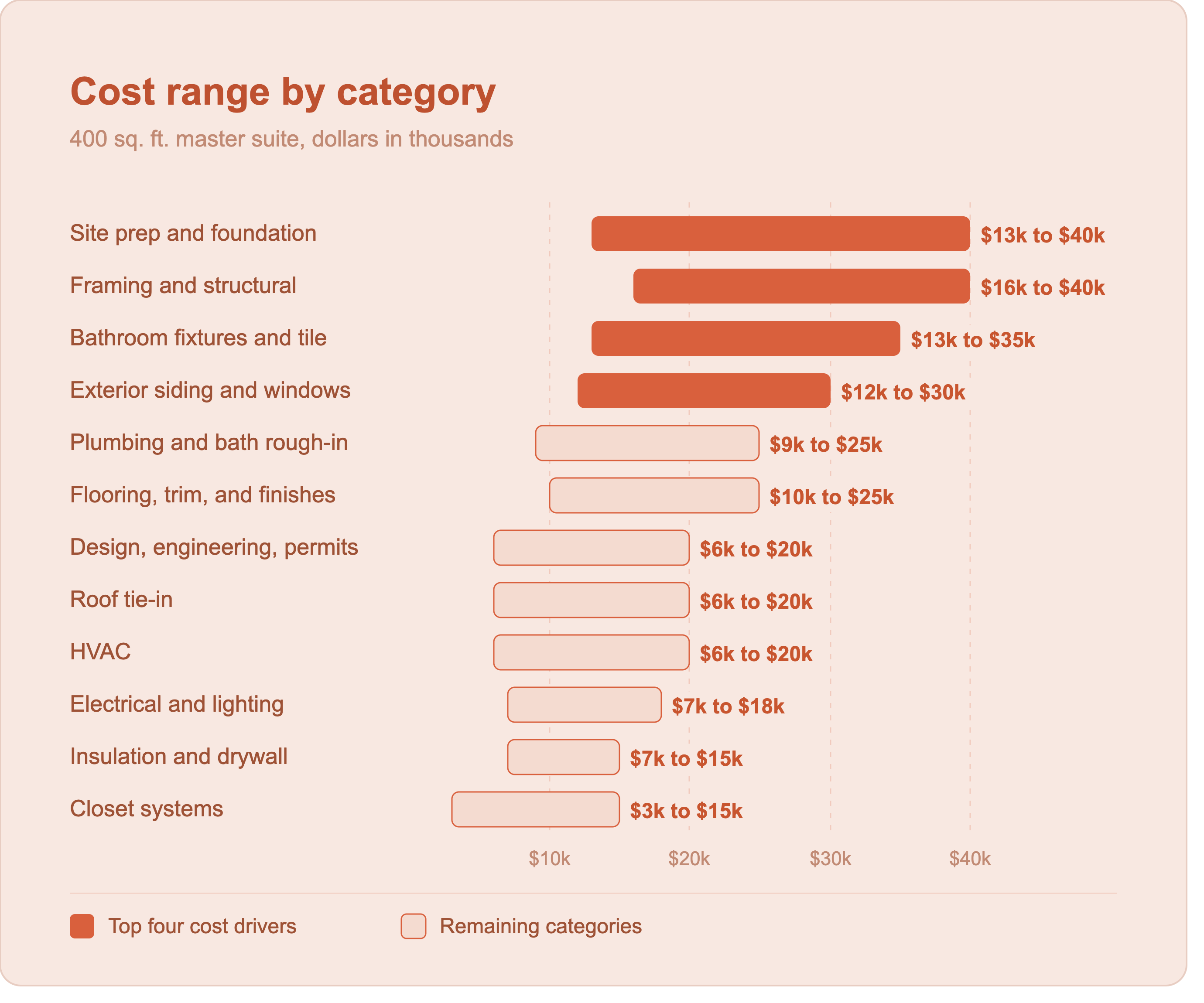
The same 400 sq. ft. suite can cost very different amounts depending on which path fits your house, and the build method usually moves the number more than the finishes do.
This is usually the lowest-cost path. You reuse existing floor, walls, or roof and add only a small extension, or none at all. It works best when the new bathroom can sit near existing plumbing, which keeps the priciest trade short. The compromise is layout. You are working within the existing structure, so the suite may not sit exactly where you would put it on a blank lot.
A rear or side addition is the most common way to build a true suite. It requires a foundation, exterior walls, a roof tie-in, siding, windows, and a full interior buildout, so it costs more than a conversion. Whether it costs less than building up depends on the site: access, soil, slope, drainage, and how cleanly the new roof connects to the existing one.
Building up preserves yard space, which is the main reason homeowners choose it. It often costs more than a ground-floor addition, because carrying new weight overhead takes structural work on top of the framing. The existing foundation and framing have to be evaluated and frequently reinforced, and the job adds stairs, structural engineering, temporary weatherproofing, and rerouting of mechanical systems. A suite over an existing garage can be a good value when the structure below is already sound and the utilities are close.
In an expensive metro, or at a premium finish level, the same footprint costs much more. Premium tile, a custom closet, a freestanding tub, a dedicated HVAC zone, exterior detailing matched to an older home, and strict permitting all stack up until the project clears $300,000.
Yes, 400 square feet is enough for a comfortable suite, but circulation, door swings, closet depth, and bathroom clearances eat into the total quickly. The right split depends on how you weigh sleeping space against the bathroom and a walk-in closet. Three layouts fit the footprint.
Add bathroom and closet space and the sleeping area shrinks to match. Awkward tie-ins and long hallways eat into usable square footage too, so the circulation plan deserves attention early, before the layout gets locked.
Most of these never come up in a first contractor conversation, but they show up often enough to plan for.
Permits shape your schedule as much as your budget. What a jurisdiction allows, and how long it takes to approve, sets when you can break ground (the point where demolition or construction legally begins).
A primary suite addition often requires several permits and reviews:
A realistic timeline for a project this size looks roughly like this:
High-cost and heavily regulated markets sit at the long end of every stage. If your timeline is tight, permitting is the stage to start early, since it is the longest and least predictable part of the schedule.
A primary suite addition is usually a lifestyle-first investment. It can improve resale value, especially if your home lacks a true primary suite compared with nearby comps, but you should not assume a dollar-for-dollar return on what you spend.
Some of that square footage pays back better than the rest. Quinn Babcock, a licensed contractor and partner at Limited Addition, points to bedrooms and bathrooms as the space that returns the most:

"From an investment standpoint, adding usable square footage, particularly bedrooms, and additional bathrooms often provides the strongest return. These improvements increase how many people can comfortably live in the home and tend to be highly valued by buyers. Homeowners should also keep in mind that increasing square footage can lead to higher property taxes."
Resale value holds up best when several things are true:
A permitted suite that fixes a genuine shortfall in your floor plan tends to pay back more at sale than a heavily customized suite in a home that is already at the top of its block.
On a project this size, how you build saves more than swapping to cheaper materials. The biggest cut comes from where you put the bathroom. Keep it near existing plumbing and the supply and drain runs stay short, which is the single largest saving on a suite addition. Converting or bumping out instead of building ground-up saves at the structural level, since reusing existing walls and roof avoids a new foundation and a full tie-in. A simple roofline and standard window sizes hold down material and labor both, since off-the-shelf windows and a clean roof connection cost far less than custom work.
Smaller moves help too. Semi-custom or modular closet systems deliver most of what full custom millwork does for a fraction of the price. Locking the scope before construction heads off change orders, which are the main reason these budgets grow mid-project. Matching your finish level to comparable homes nearby protects resale better than finishing above the block.
Bids for the same suite can vary by tens of thousands of dollars, mostly because each contractor assumes a different scope. Those assumptions usually cover:
The lowest bid is often the one missing scope, so the line items matter more than the bottom number. The vetting that protects you most happens below the general contractor, with the subs who actually rough in the plumbing and electrical. Steven Morgan, Head of Technical Training and Development at 24hr.supply and a master plumber and certified HVAC technician, puts the most useful question this way:
"Ask them to provide the names and license numbers of the specific plumbers and electricians who will actually be on your job, and tell them you're going to verify. Most homeowners ask whether the general contractor is licensed and stop there. They never vet the subs. I've been called in to fix additions where a contractor hired an unlicensed handyman to rough in the plumbing, and the work was bad enough that we had to open finished walls to correct it. The question isn't 'are you licensed?' It's 'who exactly is doing my plumbing, can I see their license, and have they worked with you before?' That single question tells you more about a contractor than anything else you could ask."
– Steven Morgan, Head of Technical Training and Development, 24hr.supply
To get bids you can actually compare, give every contractor the same information before they price the work:
Block can help you define the scope before you compare contractor quotes, so you are not weighing one complete bid against another that quietly leaves out major work.
Few homeowners pay for a six-figure addition out of pocket, and the financing path you choose affects how much suite you can afford. Common options include:
Terms, rates, and eligibility vary by lender and by your financial situation, so confirm the specifics with a lender before you set your budget. Treat this as general information rather than financial advice.
A 400 sq. ft. master suite is one of the larger projects a homeowner takes on, and most of the budget risk is set before the first contractor walks the site. The more clearly you define the bedroom, bathroom, and closet you want, along with the build method that fits your house, the more useful every bid becomes. Block helps you scope the work, match with vetted local contractors, and compare expert-reviewed quotes side by side, so you can see exactly what each one is and is not pricing.
Remodel with confidence through Block

Connect to vetted local contractors
We only work with top-tier, thoroughly vetted contractors

Get expert guidance
Our project planners offer expert advice, scope review, and ongoing support as needed
Enjoy peace of mind throughout your renovation
Secure payment system puts you in control and protects your remodel

Renovate confidently with Block
Easily compare quotes from top quality contractors, and get peace of mind with warranty & price protections.
Living Space
Bump Out Living Room: Cost, Feasibility & Options
09.06.2026
Closet
Bump Out Closet Addition: Sizing and Cost by Closet Type
08.27.2026
Additions
Bathroom Bump Out Ideas, Costs & Planning
08.27.2026
Additions
Two Story Addition at the Back of the House: Cost, Design, and Scope
08.19.2026
Additions
400 Sq. Ft. Master Suite Addition Cost: 2026 Guide
06.30.2026